
Interview of an Extraordinary Life
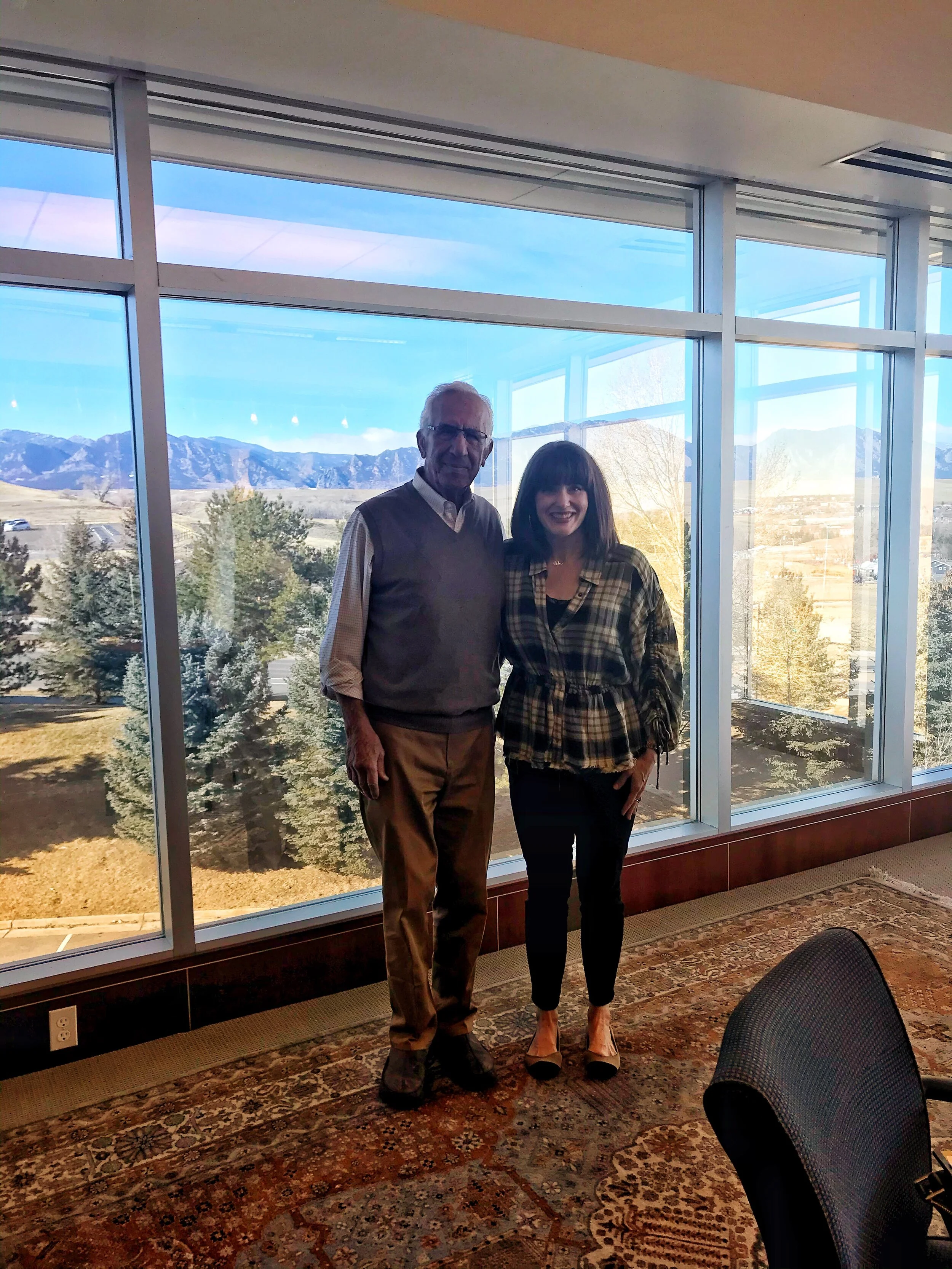
Jesse and I at his offices in Superior, Colorado.
I’ve met quite a few original Palestinian refugees who were displaced in 1948. But, it was always in the Middle East, in Lebanon to be specific. I’ve sat on floors of refugee camps and listened as they shared their stories of displacement and showed me keys or deeds to their homes in Palestine. I’ve also sat in beautiful homes in Beirut and listened to Palestinians who fled in 1948 but who were offered Lebanese citizenship. All of them offer a tapestry of Palestinian culture and tragedy of what was lost.
I haven’t met an original Palestinian refugee in my own country until recently. In Colorado, of all places, which has a very small Palestinian community. This past November, I had lunch with Jesse Issa Aweida. He was incredibly gracious with me and encouraging about my work. I slowly realized who he was and what he had done for Colorado. I asked to interview him because I think his story is a powerful example of determination and what happens when you take advantage of opportunity.
Jesse Issa Aweida was one of the founders of StorageTek in Louisville, Colorado in 1969. By, 1982 it was a 1 billion dollar company, employing over 10,000 people at 100 worldwide locations. In 1985, Jesse founded Aweida Venture Capital where he continued investing in storage, life sciences, and software.
Jesse Issa Aweida was born in Rafidya, Palestine. When he was one, his family moved to Haifa, a port city in Palestine. His father was from Nablus and his mother was from Jerusalem. He grew up the youngest of four sons. His recollections of his childhood involve the sea and a multi-cultural community. His family lived on Mount Carmel next to the Baha’i gardens, that he and others used as a playground. He also remembers the Haifa harbor and visiting the sea every day during summer vacations.
He recollects how he and his brothers tried to make money by selling Christmas trees to the Christian Palestinian population. By 1947, he was 16 years-old, and he remembers being in the harbor watching British forces deny entry to boats carrying Jewish Europeans into the port. He watched as people jumped into the sea and swam their way into Palestine and entered illegally. At this point, the United Nations declared the state of Israel and partitioned Palestine.
He stated that the Israelis were organized and there were no Arab armies in sight to help the Palestinians. By this time, his family decided it wasn’t safe for young people in Haifa. By 1948, the conflict was worsening, two of his brothers went to Egypt, the other, Jordan, and he went to Nablus to stay with relatives. His parents stayed in Haifa.
In the fall of 1949, he wanted to go back home and see his parents. There was no legal way of returning to Haifa which was now under Israeli control. He joined an organized group; the plan was to cross the border illegally together. Jesse was caught, put in jail, and deported to Lebanon. Looking back, he states that as a young man, he viewed it as quite an adventure.
While in Beirut, he learned that Aramco was holding interviews for work in Saudi Arabia. He had no appointment and showed up at an interview and actually got the job. He spent two years in Saudi working for Aramco. He met two engineers from the U.S. that encouraged him to apply to colleges in the U.S.
In 1952, he was accepted to Swarthmore College near Philadelphia. He had saved up enough money for his first year. While on the Dean’s List, he received a scholarship while he continued to work part-time and continued his studies. He graduated with his degree in engineering. While at college, he met his soon-to-be wife and shortly after graduation they were married. In 1956, he was offered a job by IBM and moved to Poughkeepsie, New York.
He transferred to Boulder with IBM and moved his family to Boulder in 1965. During this time, his father and all three of his brothers joined him in Boulder. A few years later with three other men, he started StorageTek which for a while was one of the largest employers in Colorado.
He has been married for 61 years and has 5 children and 11 grandchildren. When we ended the interview, I asked him what he wanted his legacy to be. He says he is proud to be both American and Palestinian. He has been in America longer than he was in Palestine - his wife and children are American. He is also proud of his Palestinian heritage. He wants to be known as someone who took advantage of the opportunities that he was presented with in his life. That he used his influence and resources to help others.
Mostly, that he was able to offer a foundation of opportunities to his children. He hopes for them to have long lives and to be successful. And maybe that is his greatest legacy; he always wanted a big family, and now his children and grandchildren can continue to live out his successes, determination, and dreams.